

This build is a small timing belt drive setup designed for CNC linear motion testing and light automation applications. The goal is to compare belt tension, pulley alignment, tooth profile selection, and motion stability in a simple belt-driven axis.
The setup can be used as a reference for CNC routers, 3D printers, engraving machines, desktop automation projects, and other motion systems where a timing belt is used to transfer movement from a stepper motor to a linear axis.
Main design points:
1. Belt selection
A timing belt should be selected according to load, speed, positioning accuracy, pulley diameter, and available installation space. GT, HTD, AT, and T tooth profiles are commonly used in motion systems, depending on the application.
2. Pulley alignment
Correct pulley alignment is important for reducing belt wear, noise, vibration, and uneven movement. Misalignment may cause the belt to run against the flange or wear on one side.
3. Belt tension
The belt should be tensioned enough to prevent backlash or tooth jumping, but excessive tension can increase bearing load and shorten belt life.
4. Belt material
Rubber timing belts are often used in industrial transmission systems because they provide stable operation, flexibility, low noise, and good vibration absorption. PU timing belts may be considered for applications requiring higher dimensional stability or cleaner operating conditions.
5. Application environment
Dust, temperature, oil, machine duty cycle, and repeated acceleration or direction changes can all affect belt performance and service life.
This simple belt drive setup is useful for observing how different belt widths, pulley sizes, and tensioning methods influence CNC motion performance.Rubber timing belt technical reference
Rubber Timing Belt Manufacturer | Synchronous Drive | Conxu
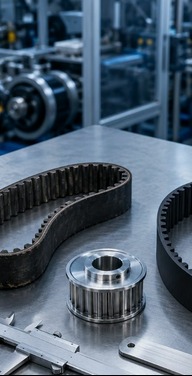
Timing Belt Drive Setup for CNC Linear Motion
Build in 'Cartesian Style CNC' published by Conxu, Jul 15, 2026 at 10:31 PM.
A small timing belt drive setup for CNC linear motion testing, focused on belt selection, pulley alignment, belt tension, and motion stability.
-
-
Build Author Conxu, Find all builds by Conxu
-
- Loading...
-
Build Details
- Build License:
-
- CC - Attribution - CC BY
Reason for this Build
The purpose of this build is to create a simple reference setup for testing timing belt performance in CNC linear motion systems. It helps compare belt tension, pulley alignment, tooth profile selection, and motion stability before applying the belt drive to a larger CNC or automation project.Inspired by
Inspired by common CNC router, 3D printer, and small automation machine belt drive structures.